PROFITABILITY & CASH
When Revenue Grows but Cash Tightens
When a growing company reports stronger revenue and profitability, but the working-capital requirements of that growth begin to exceed its available cash.
The Business Situation
A founder-led consumer products company is experiencing strong commercial growth.
Revenue is increasing. Gross margins are stable. Operating profit is improving. Wholesale customers are placing larger orders, and new distribution opportunities are emerging.
By conventional measures, the business appears to be moving in the right direction.
Yet its cash balance continues to decline.
The company is generating more revenue, but it has less liquidity available to finance inventory, meet operating commitments, and respond to unexpected demands.
The founder is now considering another inventory purchase to support anticipated demand.
Her sales team believes the opportunity should be pursued. Operations expects to fulfill the additional volume. Finance is concerned that the company's available cash will fall further below its minimum operating reserve.
Each perspective has merit.
The central question is not simply why cash is declining while revenue grows.
It is whether the company can continue financing its growth under the existing operating model—or whether the financial structure supporting that growth must change.
01 — Establishing the Economic Reality
Consider Aster & Vale, a fictional consumer products company generating approximately $4 million in annual revenue.
Over three months, its financial performance improves.
Illustrative Operating Performance
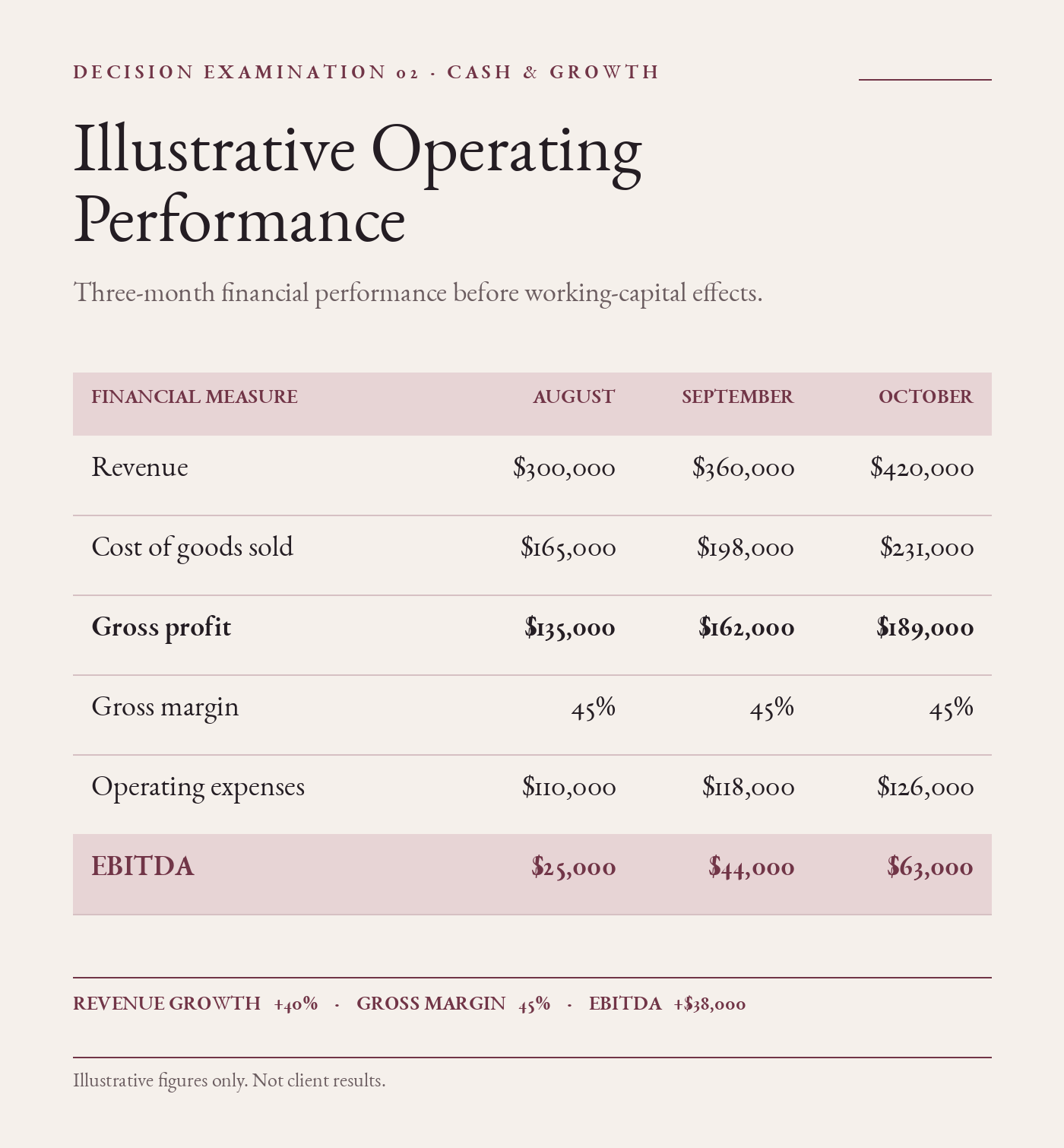
Revenue increases by 40% between August and October.
Gross margin holds steady at 45%, while monthly EBITDA increases from $25,000 to $63,000.
These are encouraging results.
The company is not obviously experiencing a decline in its underlying operating profitability.
But reported profit does not establish how much cash the business has available.
A company can recognize revenue before collecting payment. It can purchase inventory months before selling it. And it can make debt payments or capital investments that do not appear as operating expenses in the same way.
The relevant distinction is between economic performance and cash availability.
A growing business may be profitable while still requiring substantial additional capital to sustain that growth.
02 — Examining the Cash Requirement
The company's cash position tells a different story from its income statement.
Illustrative Cash Commitment
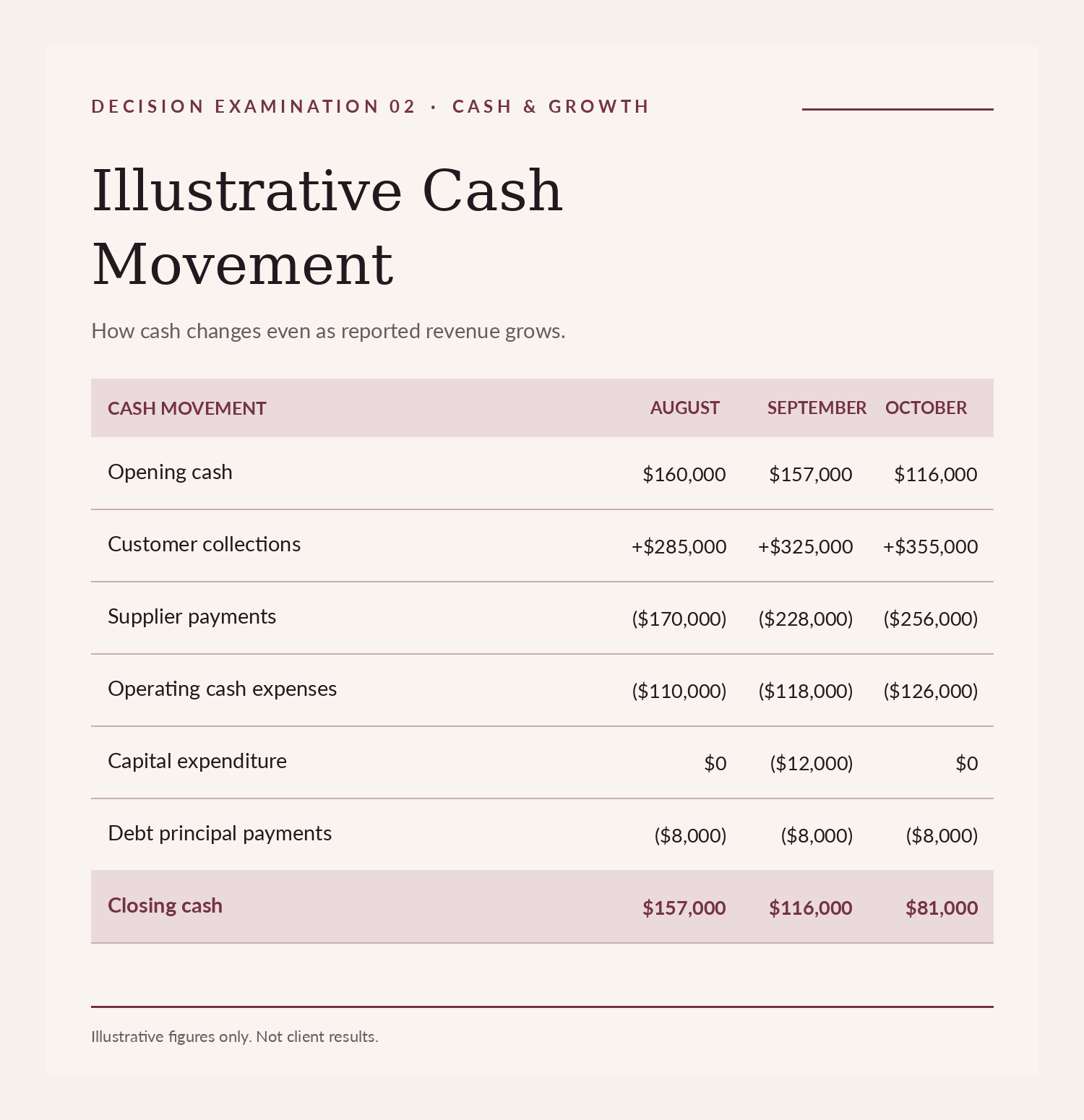
Over three months, the company generates $1.08 million in recognized revenue but collects only $965,000 from customers.
The $115,000 difference suggests that an increasing portion of the company's sales has not yet been converted into cash.
If the company's revenue and collections flow through ordinary trade receivables, that difference would indicate an approximately $115,000 increase in accounts receivable, subject to reconciliation for other adjustments.
Supplier payments also exceed recognized cost of goods sold over the period.
That difference may reflect inventory purchases ahead of future sales, changes in supplier payment timing, or a combination of both.
The available information does not yet establish exactly how much cash is tied up in inventory versus changes in payables.
But the overall pattern is clear.
The company is making substantial cash commitments before recovering the cash associated with its sales.
During the same period, its cash balance falls from $160,000 to $81,000.
Available Liquidity
Assume the founder has established a minimum operating cash reserve of $100,000.
The October closing balance is now $19,000 below that threshold.
The reserve breach does not automatically mean the company is unprofitable or unable to meet its obligations.
It does indicate that the company has used part of the financial protection the founder intended to preserve.
The decision therefore changes.
Leadership is no longer examining growth solely through revenue, margin, and profitability.
It must understand the working-capital requirement created by that growth—and whether the company can finance the resulting commitments without compromising its operating flexibility.
03 — Identifying the Operating Pressure Behind the Numbers
The cash shortage may appear in the finance reports, but its underlying causes can originate throughout the business.
Wholesale customers may require extended payment terms.
Larger orders may require additional inventory before the associated revenue is collected.
Suppliers may demand deposits or payment before shipment.
Certain products may move quickly while others remain in the warehouse.
And the sales team may commit to delivery schedules without seeing the full cash requirements those commitments create.
Each activity can be commercially reasonable in isolation.
Together, however, they influence how much financing the business requires.
Consider a simplified sequence.
A retailer places an order.
The company commits to manufacturing the products.
The manufacturer requires payment before delivery.
The retailer receives the goods and pays on agreed terms.
During the period between production payment and customer collection, the company must finance the transaction.
If additional orders arrive before earlier ones have been collected, that financing requirement can grow even while reported profitability improves.
The relevant question is not simply whether inventory is selling.
It is how much cash the company must commit, for how long, and with what degree of certainty that the expected receipts will arrive.
This is where cash conversion becomes a strategic consideration.
A profitable sales channel may still place disproportionate demands on working capital.
An increase in revenue may create economic value while also increasing the amount of cash the company needs to operate.
Neither conclusion should be confused with the other.
04 — Evaluating the Alternatives
The founder is considering another production commitment.
Finance prepares a preliminary November forecast using the current purchasing and collection assumptions.
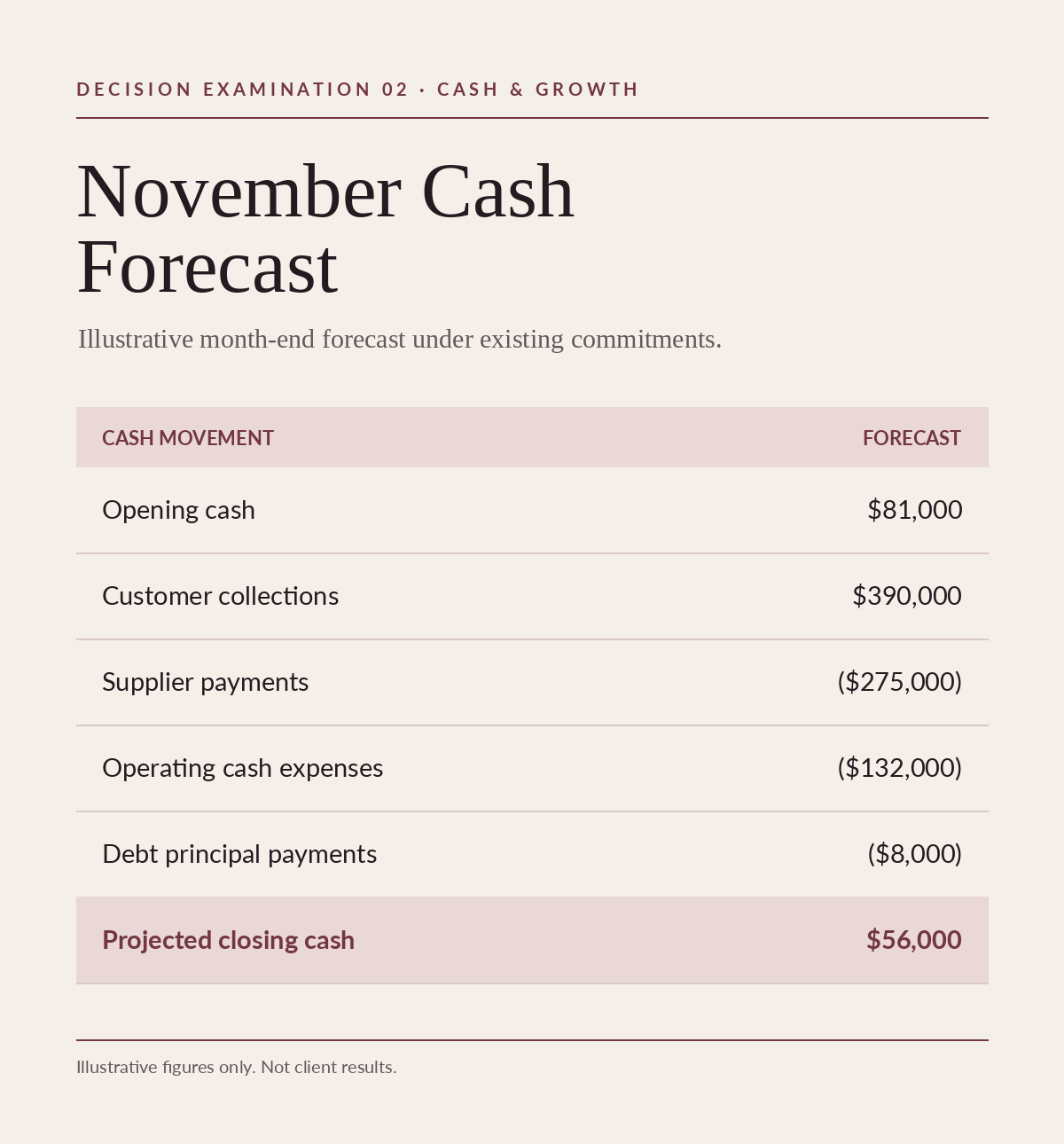
Under the current forecast, the company's month-end cash balance would fall to $56,000—$44,000 below its minimum reserve.
This is only a month-end view. It does not establish the lowest cash balance during the month, which could be materially lower depending on payment dates.
Leadership therefore needs a dated cash forecast before committing additional funds.
But the preliminary results are sufficient to identify several alternatives.
Scenario A — Continue Under Existing Terms
The company proceeds with its planned inventory purchases and accepts the current customer payment arrangements.
This preserves its growth plans and avoids disrupting existing commercial relationships.
If collections arrive as expected and the inventory generates the projected sales, the company may recover cash over subsequent periods.
However, the strategy leaves the business exposed to further liquidity pressure.
It also assumes that the company can meet every payment obligation as it falls due, something the month-end forecast alone cannot establish.
Proceeding unchanged may preserve near-term sales opportunities, but it does not address the current financing constraint.
Scenario B — Improve Customer Payment Terms
The company negotiates deposits on selected wholesale orders or accelerates collections on new commitments.
Assume these changes bring an additional $45,000 of cash into November without changing total expected customer payments.
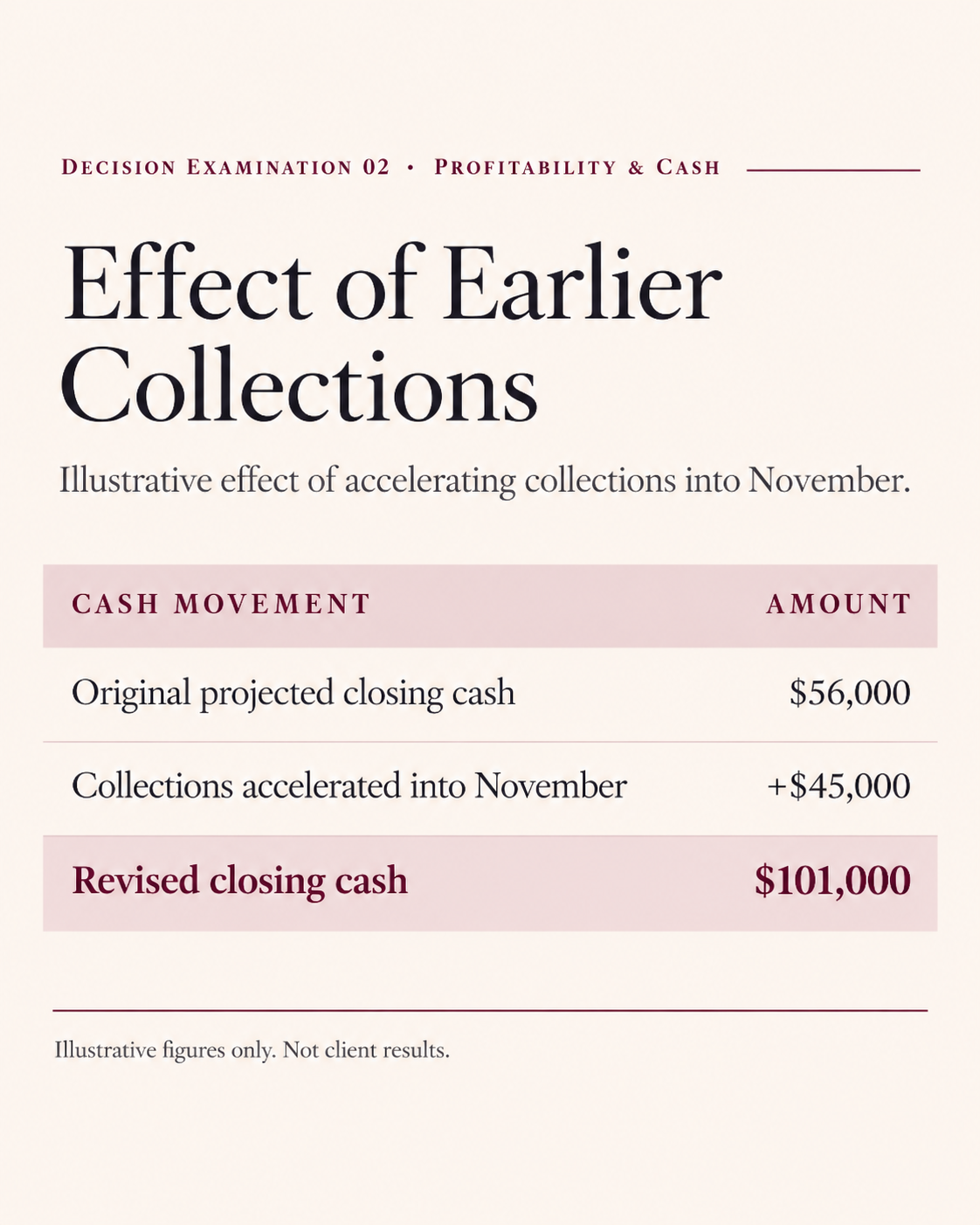
Under these assumptions, the company would finish November just above its minimum reserve.
But earlier collections are not the same as additional profit.
The company still has to fulfill its obligations, and the customer may require concessions in exchange for revised terms.
The scenario also leaves only $1,000 above the reserve.
That limited headroom may be insufficient if customer payment is delayed, production expenses increase, or another operating requirement arises.
Improving collection terms may make growth easier to finance.
It does not automatically establish that the resulting cash position is sufficiently resilient.
Scenario C — Reconfigure Inventory Commitments
The company reviews planned production and identifies purchases that can be reduced or postponed without violating existing supplier or customer commitments.
Assume it can defer $50,000 of November supplier payments.
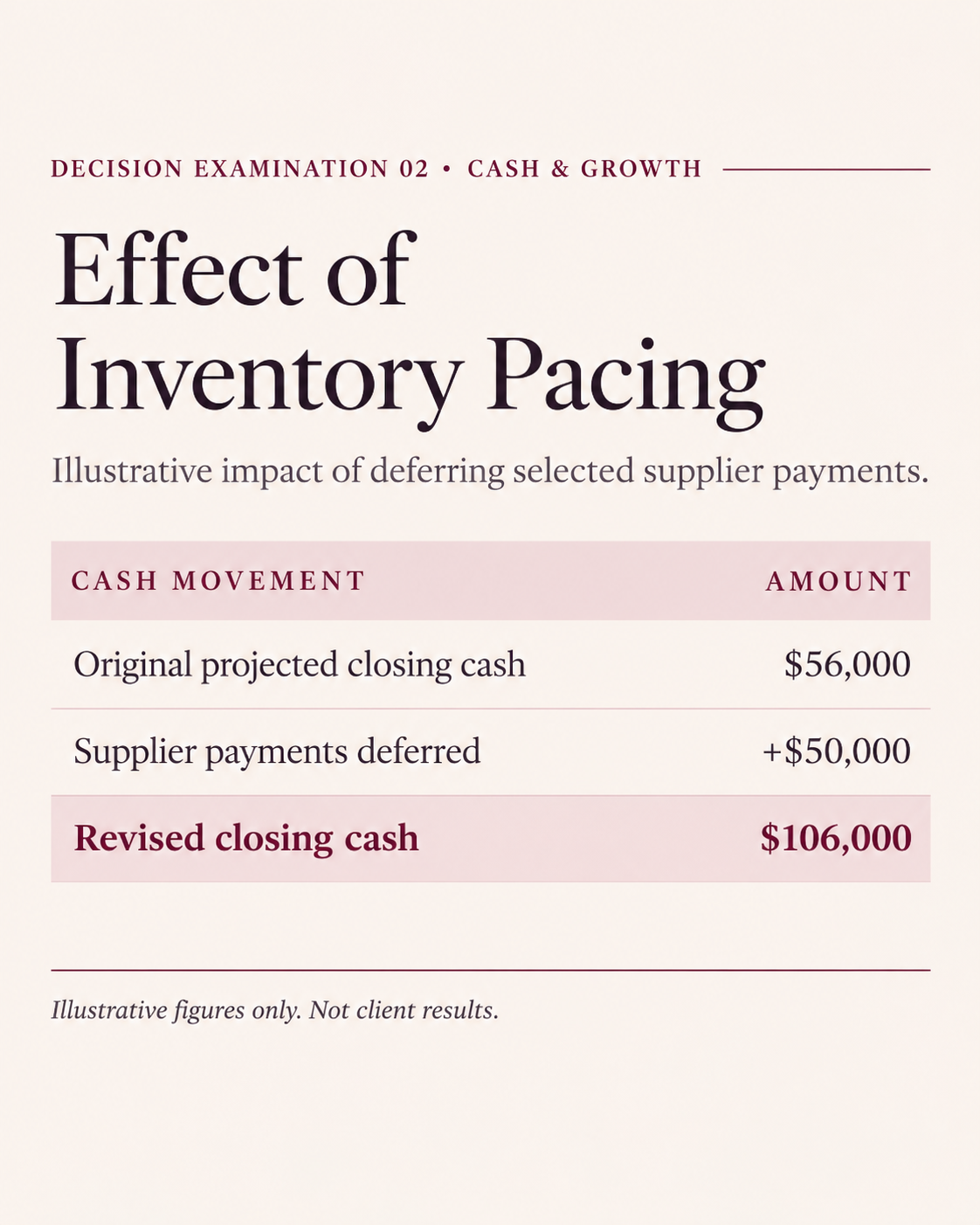
The immediate cash position improves.
However, the economic consequences depend upon which inventory commitments are delayed.
If the postponed production would have supported high-confidence, high-contribution demand, the company may sacrifice valuable future sales.
If the purchases relate to uncertain demand or products with weak sell-through, delaying them could preserve liquidity without a comparable loss of economic value.
The decision therefore requires more than reducing the total purchase order.
Leadership needs to understand which inventory commitments create the greatest economic return relative to the cash, time, and operating capacity they consume.
Scenario D — Secure Working-Capital Financing
The company explores a $75,000 working-capital facility to finance the difference between cash payments and customer collections.
Assume the facility is available and the full amount can be drawn during November.
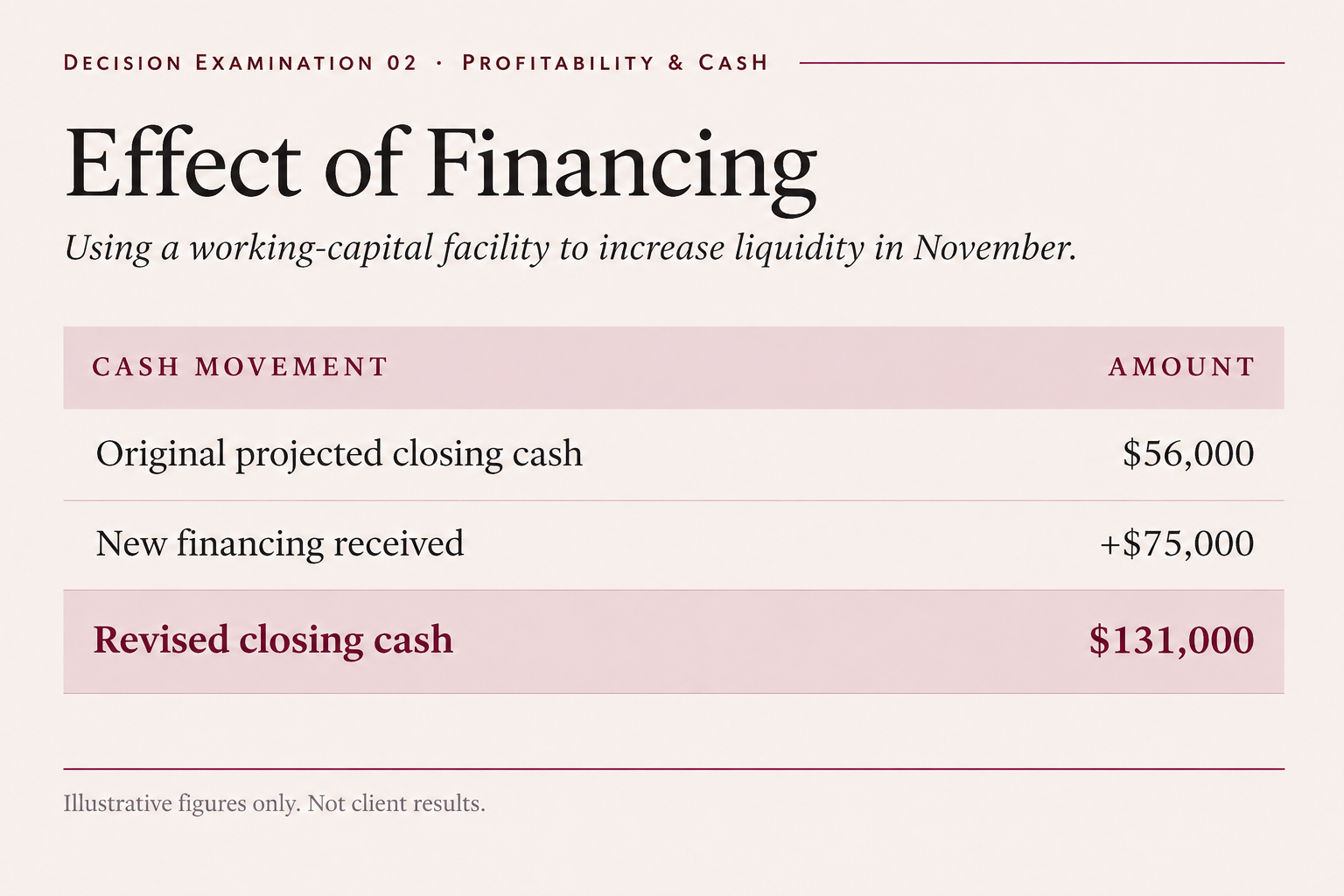
This scenario preserves the original inventory and customer commitments while increasing available liquidity.
But borrowing is not equivalent to creating operating cash flow.
The company assumes an additional financial obligation, potentially including interest, fees, collateral, guarantees, or lending covenants.
Financing may be appropriate when the underlying sales are economically sound and the working-capital requirement is predictable.
It may be less appropriate if the company is repeatedly financing slow-moving inventory, declining contribution margins, or commitments that do not generate sufficient cash to repay the borrowing.
The quality of the financing decision depends upon the quality of the underlying cash-generation model.
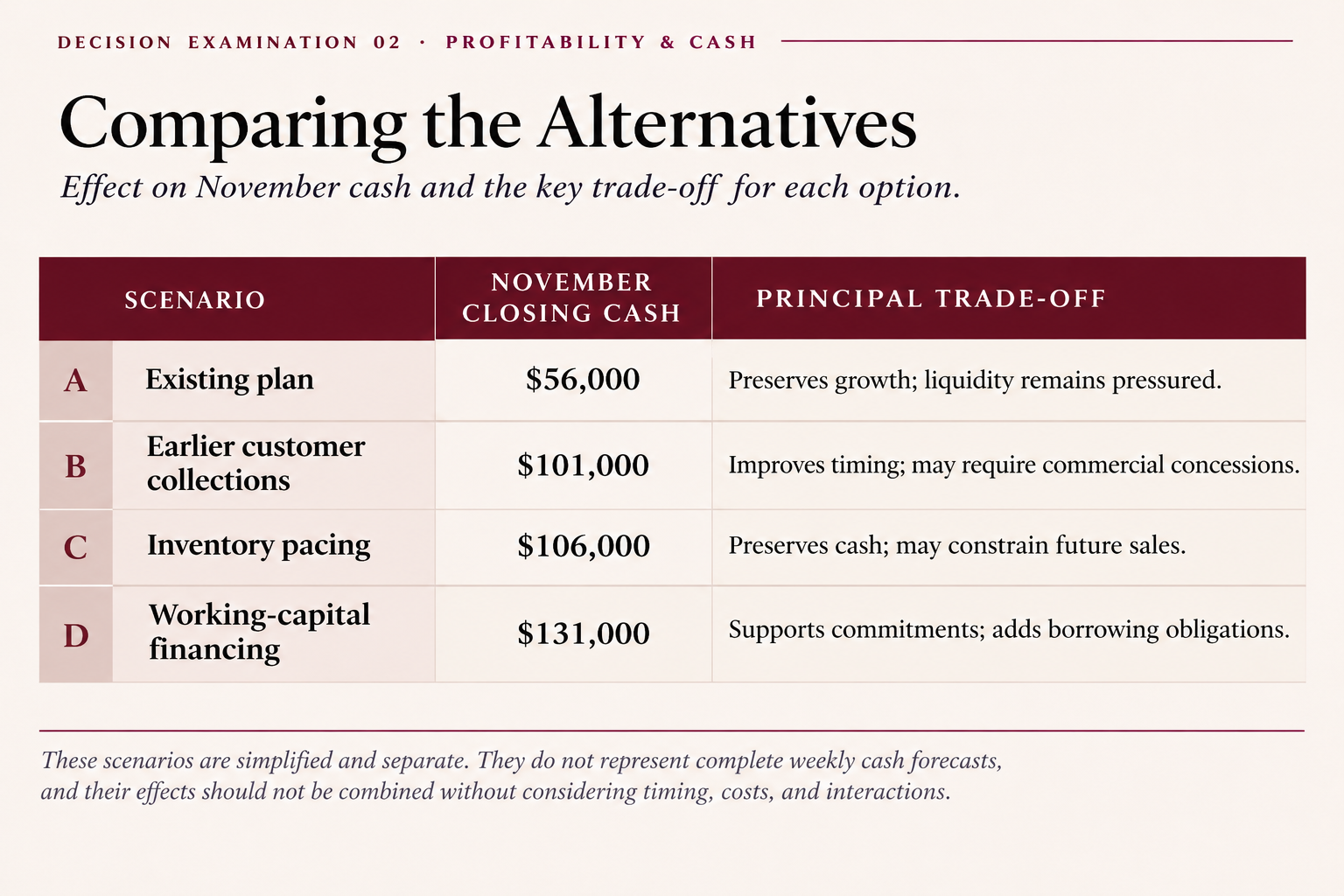
These scenarios are simplified and separate. They do not represent complete weekly cash forecasts, and their effects should not be combined without considering timing, costs, and interactions.
The alternative producing the highest closing cash balance is not necessarily the strongest economic decision.
The founder must evaluate what each option produces, what it requires, and what risks it transfers elsewhere in the company.
05 — Testing Whether Growth Can Be Financed Responsibly
Before selecting one of the alternatives, the company needs to determine whether the cash pressure is temporary or structural.
A temporary timing difference may be manageable if customer payments are reliable, inventory is productive, and cash inflows are expected to recover within a defined period.
A structural financing requirement is different.
If every additional increase in revenue requires a larger inventory commitment and longer customer credit, the company may need recurring working capital simply to sustain its growth rate.
That does not make the business model inherently unattractive.
But it changes the financial resources required to operate it.
Testing the Downside
Leadership should examine what happens if:
A major retailer pays 30 days later than expected.
Inventory sells more slowly than forecast.
Manufacturing deposits increase.
Demand shifts toward products carrying lower contribution margins.
Supplier payment terms become less favorable.
A planned financing facility is delayed or unavailable.
Each possibility affects the company's cash requirements.
A decision that is financeable under the expected forecast may become much less attractive when timing and operating assumptions change.
The appropriate test is not whether the company can maintain a positive month-end balance in one scenario.
It is whether the company can meet its obligations throughout the period while preserving a level of liquidity consistent with the founder's stated risk tolerance.
That requires a rolling, dated cash forecast and explicit downside assumptions.
It also requires distinguishing between cash that is available, cash that is expected, and cash that is contractually committed.
The Question of the Operating Reserve
The $100,000 reserve is not a universal standard.
It represents the founder's intended protection against uncertainty.
Leadership should establish whether the reserve remains appropriate given the company's operating expenses, supplier commitments, payroll requirements, financing obligations, and exposure to customer payment delays.
A founder may consciously decide to use part of that reserve for a sufficiently attractive opportunity.
But that choice should be explicit.
There is a meaningful difference between accepting a temporary reduction in liquidity as part of a considered investment decision and discovering that routine growth commitments have already consumed the company's financial flexibility.
06 — Examining the Organization Behind the Cash Pressure
The financial analysis explains the cash requirement.
The organizational examination asks how those commitments are being made.
Sales may evaluate new business based on revenue potential and customer relationships.
Operations may evaluate the ability to fulfill the orders.
Finance may assess liquidity, collection timing, and financing costs.
Each function may be performing its responsibilities competently.
Yet the organization can still make commitments that are difficult to carry if the decisions are not examined together.
Several questions become important.
Finance: Who owns the integrated cash forecast? How frequently is it updated? Does leadership understand the expected cash trough before approving material commitments?
Commercial leadership: Are payment terms evaluated alongside revenue and contribution? Who has authority to offer extended credit or accept unusually large orders?
Operations: How are purchase quantities determined? What information governs inventory allocation, reorder points, and supplier commitments?
Organizational design: At what point must a significant sales or inventory decision receive cross-functional review? Who resolves competing priorities when an attractive order creates liquidity pressure?
Executive leadership: What level of cash exposure is acceptable? Which growth opportunities justify additional financing? What must be preserved as the company expands?
The goal is not to route every ordinary purchasing or sales decision through the founder.
It is to establish clear decision rights and thresholds so that material commitments receive the level of examination they deserve.
The company may already possess the necessary expertise.
What it needs is a reliable process for bringing that expertise together before financial commitments become difficult to reverse.
07 — The Executive Judgment
Under the stated assumptions, the company's revenue growth appears economically encouraging, but its current liquidity position does not support approving additional discretionary inventory commitments without further examination.
The existing plan would place projected November cash substantially below the founder's established reserve.
Improving customer payment terms could reduce the financing requirement, but the modeled improvement provides limited protection against unfavorable outcomes.
Reconfiguring inventory purchases could preserve liquidity, although the company must identify the contribution and customer commitments that might be sacrificed.
Working-capital financing may support continued growth, provided the company can demonstrate credible repayment capacity and acceptable financing terms.
The recommendation is therefore conditional.
Before authorizing the next material production commitment, leadership should establish:
A dated, integrated cash forecast showing expected collections, required payments, the lowest projected cash balance, and the consequences of delayed receipts.
A working-capital analysis identifying the receivables, inventory, and supplier terms responsible for the financing requirement, including the economic contribution associated with the relevant sales channels.
A coordinated commitment policy establishing who can approve major orders and inventory purchases, which liquidity thresholds govern those approvals, and what circumstances require additional executive consideration.
These steps may support continued growth with revised commercial terms, targeted inventory changes, financing, or some combination of those measures.
They may also reveal that a slower pace of growth is appropriate until the company's financial and operating arrangements become more resilient.
The founder's responsibility is not to maximize revenue irrespective of its financing requirements.
It is to decide which growth commitments advance the company's long-term economic strength and which obligations the organization is prepared to carry.
What This Examination Reveals
The original question was why a growing, profitable company continued to experience declining cash.
The examination reveals a more consequential set of decisions.
How much working capital does growth require?
Which customers and products are generating returns worth financing?
Can commercial terms improve the relationship between cash payments and collections?
Should inventory commitments be reconfigured?
Would outside financing strengthen the business or merely defer the underlying pressure?
And how should financial, commercial, and operating responsibilities be coordinated so that leadership can anticipate these consequences before committing?
The purpose of integrative executive advisory is not simply to identify a cash shortfall or recommend that a company slow down.
It is to examine what the financial information means for the whole organization, make the competing considerations visible, and help leadership determine the conditions under which growth can responsibly continue.
A stronger income statement can be a sign of progress.
A stronger business is one that also understands what that progress requires.
About This Examination
This is a fictional, illustrative business scenario developed to demonstrate the financial analysis, operating considerations, and executive judgment involved in The Sovereign Ledger's advisory approach. All figures and company circumstances are hypothetical. The modeling is simplified, and conclusions are conditional. This examination does not represent an actual client engagement, verified client result, or individualized financial recommendation.
Consider the Decision Facing Your Business
If your company is generating stronger revenue and improving profitability, but cash remains increasingly constrained, the most important question may not be how to generate more sales.
It may be whether your working capital, operating commitments, and financial structure can responsibly support the growth already underway.
At The Sovereign Ledger, we help established women founders examine these interconnected decisions so they can pursue growth with greater financial clarity, organizational coherence, and independent judgment.