Decision Examination 01
CAPITAL & GROWTH
The Retail Expansion Decision
When projected revenue is attractive, but the financial and operational requirements of growth may exceed the company's existing capacity.
The Business Situation
A growing consumer products company has an opportunity to expand into a major national retail channel.
The retailer proposes an initial order of 20,000 units, representing $480,000 in wholesale revenue.
The opportunity could introduce the brand to a much larger customer base, establish a valuable retail relationship, and create a foundation for future distribution.
But accepting the order requires more than producing additional inventory.
It requires the company to finance production, accommodate extended payment terms, allocate limited operating capacity, and determine whether fulfilling the order will compromise its existing direct-to-consumer business.
The central question is not simply whether the order will be profitable.
It is whether the company can finance and fulfill the commitment while protecting the economic and organizational capacity of the business it already has.
01 — Establishing the Economic Reality
Before evaluating the strategic appeal of the retailer relationship, we examine the economics of the proposed order.
Illustrative Retail Order Economics
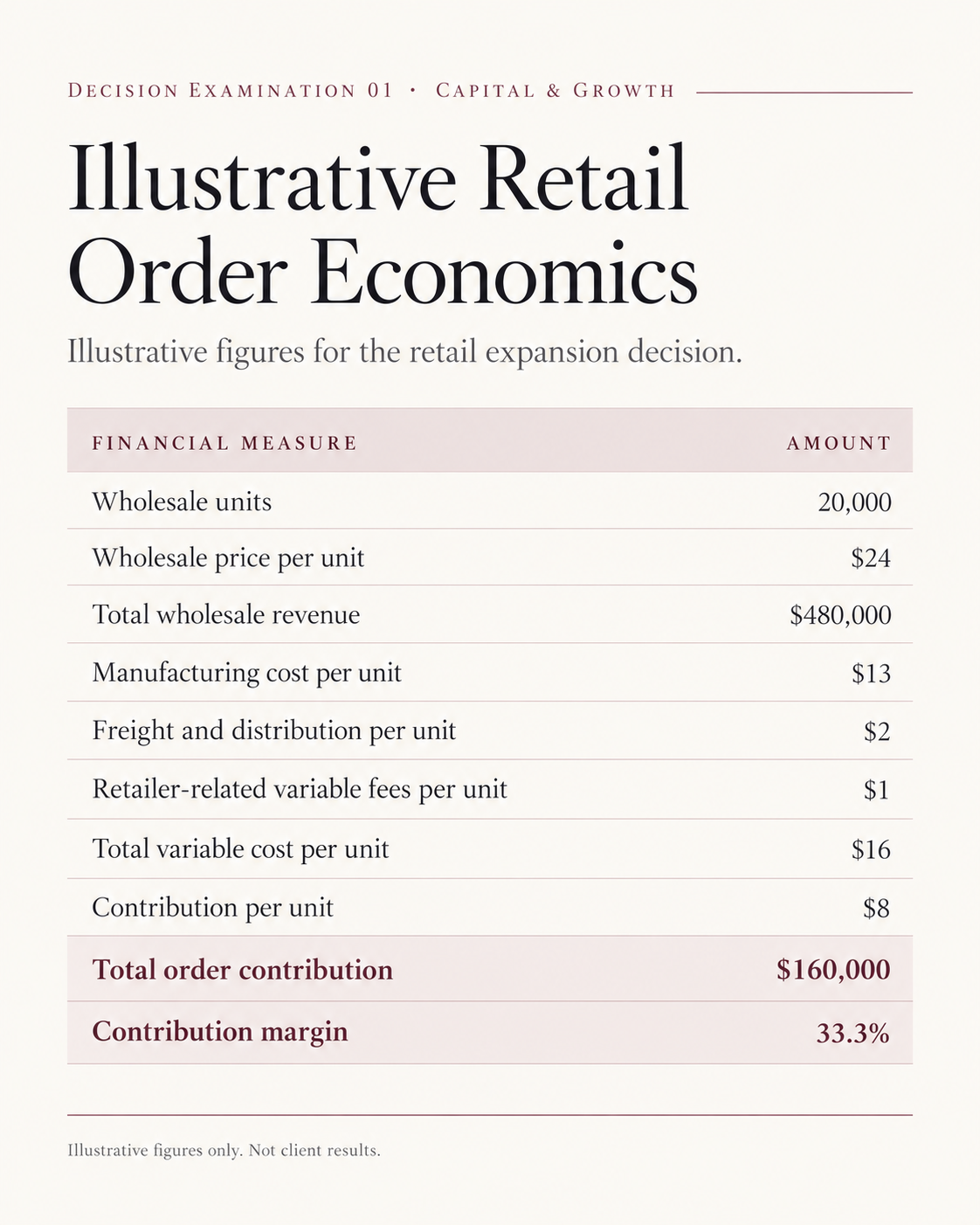
On an incremental contribution basis, the proposed order appears attractive.
The company could generate $160,000 after the modeled production, freight, and retailer-related variable costs.
But this figure does not account for financing costs, additional fixed expenses, capacity displacement, or the timing of cash receipts.
Contribution is not the same as cash availability. And an attractive margin does not establish whether the company can responsibly accept the commitment.
02 — Examining the Cash Requirement
The retailer will pay 60 days after shipment.
The manufacturer requires 50% of production costs when the order is placed, with the balance due before shipment.
Freight and retailer-related variable fees are assumed to be payable before the retailer settles its invoice.
Illustrative Cash Commitment
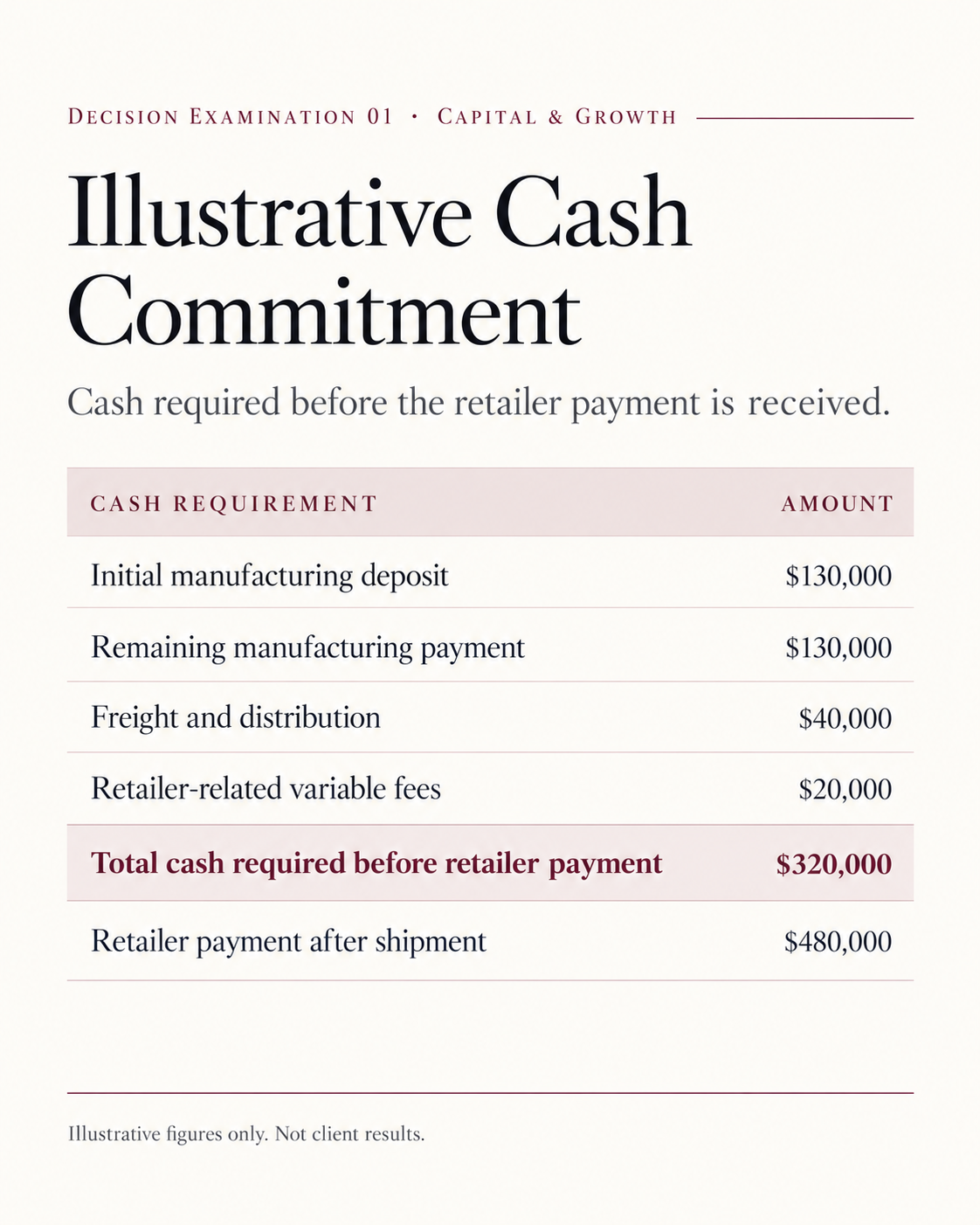
Under these assumptions, the company must fund $320,000 before receiving the retailer's payment.
The $160,000 projected contribution does not eliminate that funding requirement.
It is realized through a transaction that must first be financed.
Available Liquidity
Assume the company has:
$240,000 in unrestricted cash.
A minimum operating cash reserve of $120,000.
$150,000 in confirmed, available credit capacity.
That leaves $270,000 potentially available for the retail commitment while preserving the operating reserve.
The order requires $320,000.
The preliminary funding shortfall is $50,000.
The opportunity may be profitable, but under the current assumptions, the company cannot finance the entire commitment without additional funding, revised payment terms, or a reduction in its operating reserve.
The decision therefore changes.
It is no longer simply whether to accept the order.
It becomes a question of how to structure the opportunity so that accepting it does not expose the rest of the business to unacceptable liquidity risk.
03 — The Capacity Constraint
The financial examination reveals another important condition.
The company does not have unlimited production capacity.
Fulfilling the full retailer order through its current production allocation would displace 5,000 units otherwise intended for its direct-to-consumer channel.
Those units carry different economics.
Direct-to-Consumer Economics
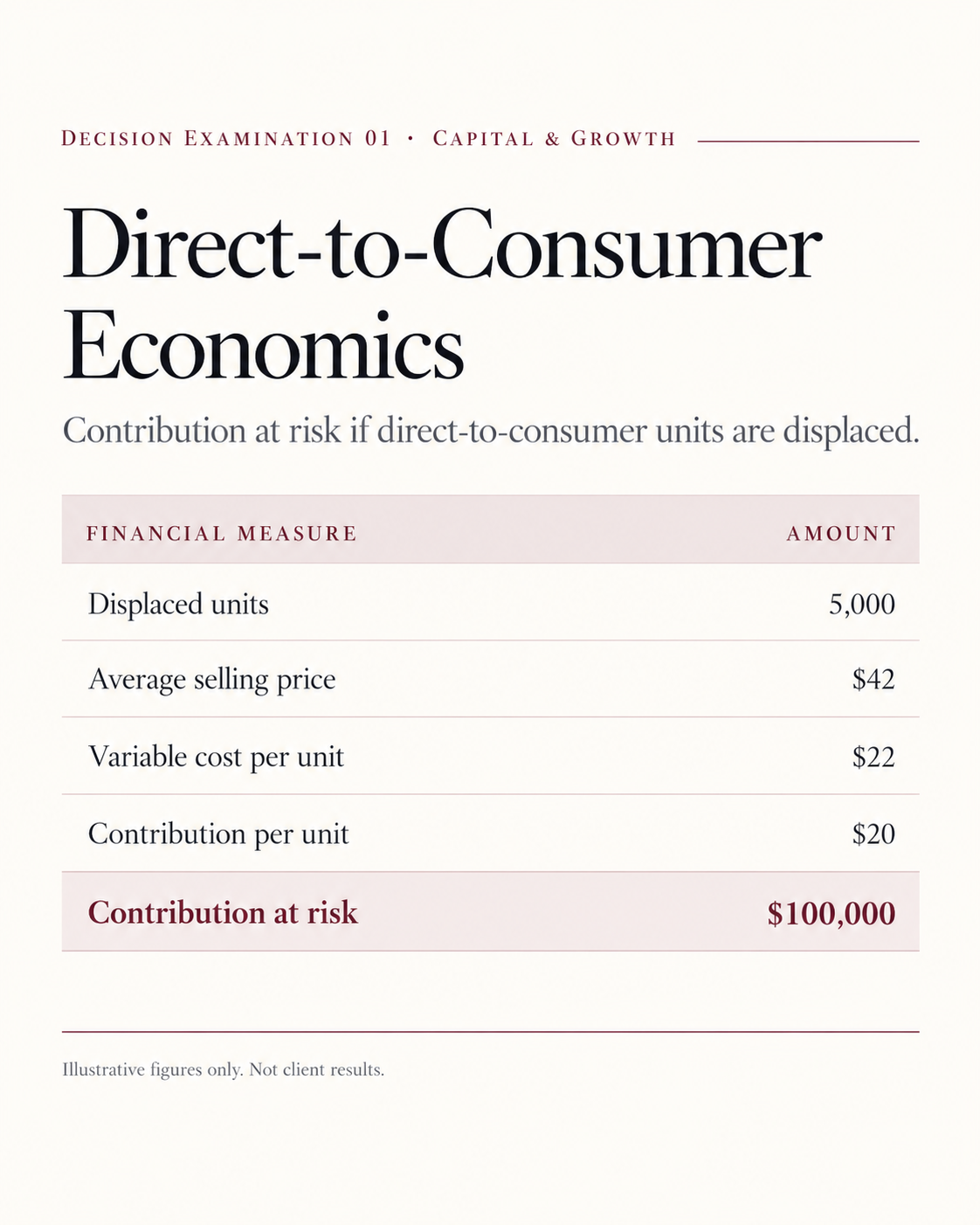
The direct-to-consumer channel generates a higher contribution per unit than the proposed wholesale order.
The company could gain $160,000 in retail contribution while sacrificing $100,000 in contribution from existing direct-to-consumer demand.
The net incremental contribution would therefore be only $60,000, before financing costs or additional overhead.
This changes the economic interpretation of the retailer opportunity.
The relevant question is not how much contribution the new order produces in isolation. It is how much additional contribution the company retains after accounting for the capacity and resources the order consumes.
04 — Evaluating the Alternatives
Rather than treating the retailer's proposed order as a simple accept-or-decline decision, we examine several possible structures.
Scenario A — Accept the Full Order Using Existing Capacity
The company accepts the 20,000-unit retailer order and reallocates enough capacity to fulfill it.
This displaces 5,000 direct-to-consumer units.
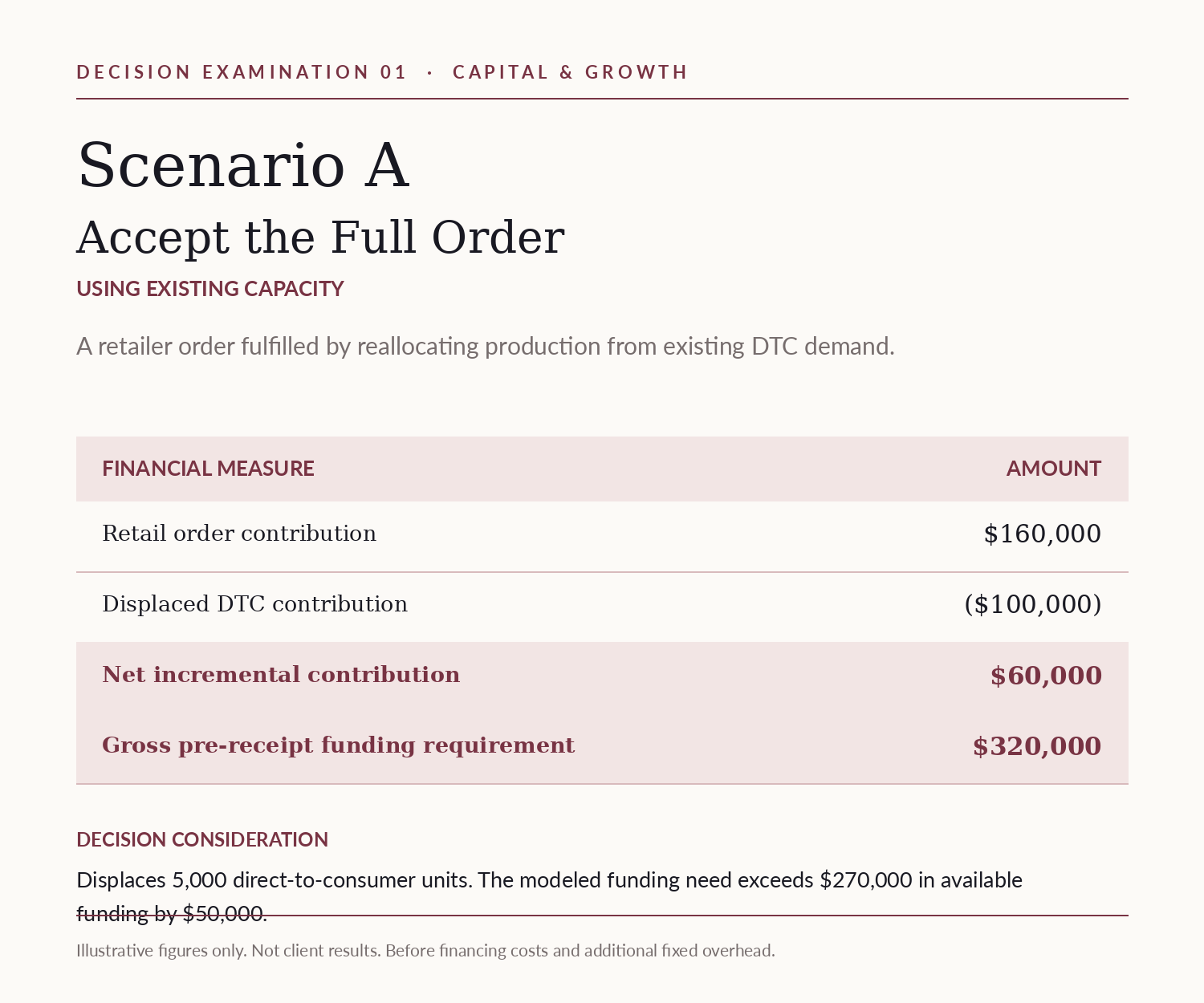
This scenario captures the retail opportunity but sacrifices existing contribution and requires more funding than the company currently has available under its minimum cash reserve policy.
Scenario B — Expand Production to Protect Direct-to-Consumer Sales
The company arranges additional production capacity to fulfill the retail order without displacing the planned direct-to-consumer volume.
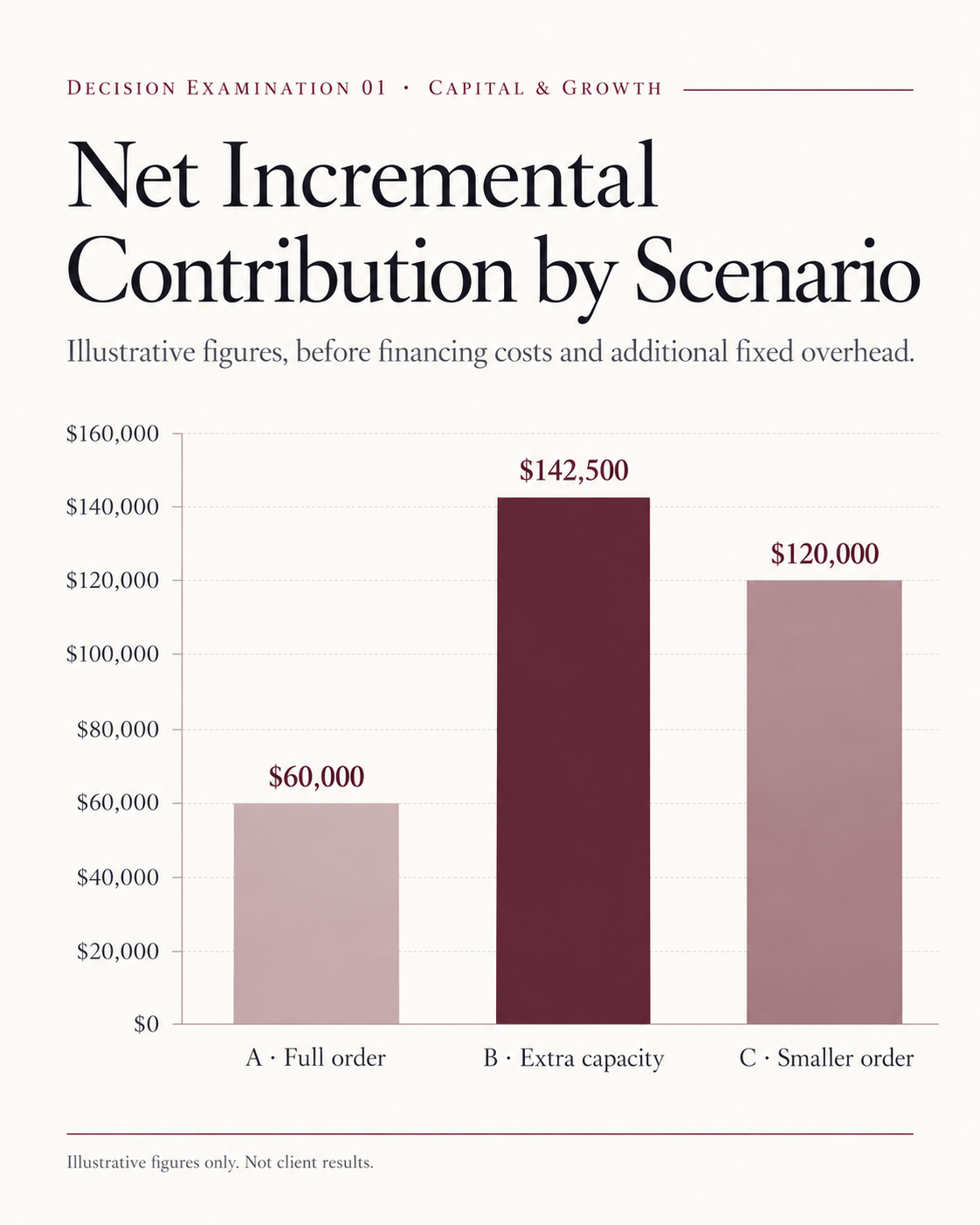
The additional production arrangement costs $17,500 beyond normal unit manufacturing costs.
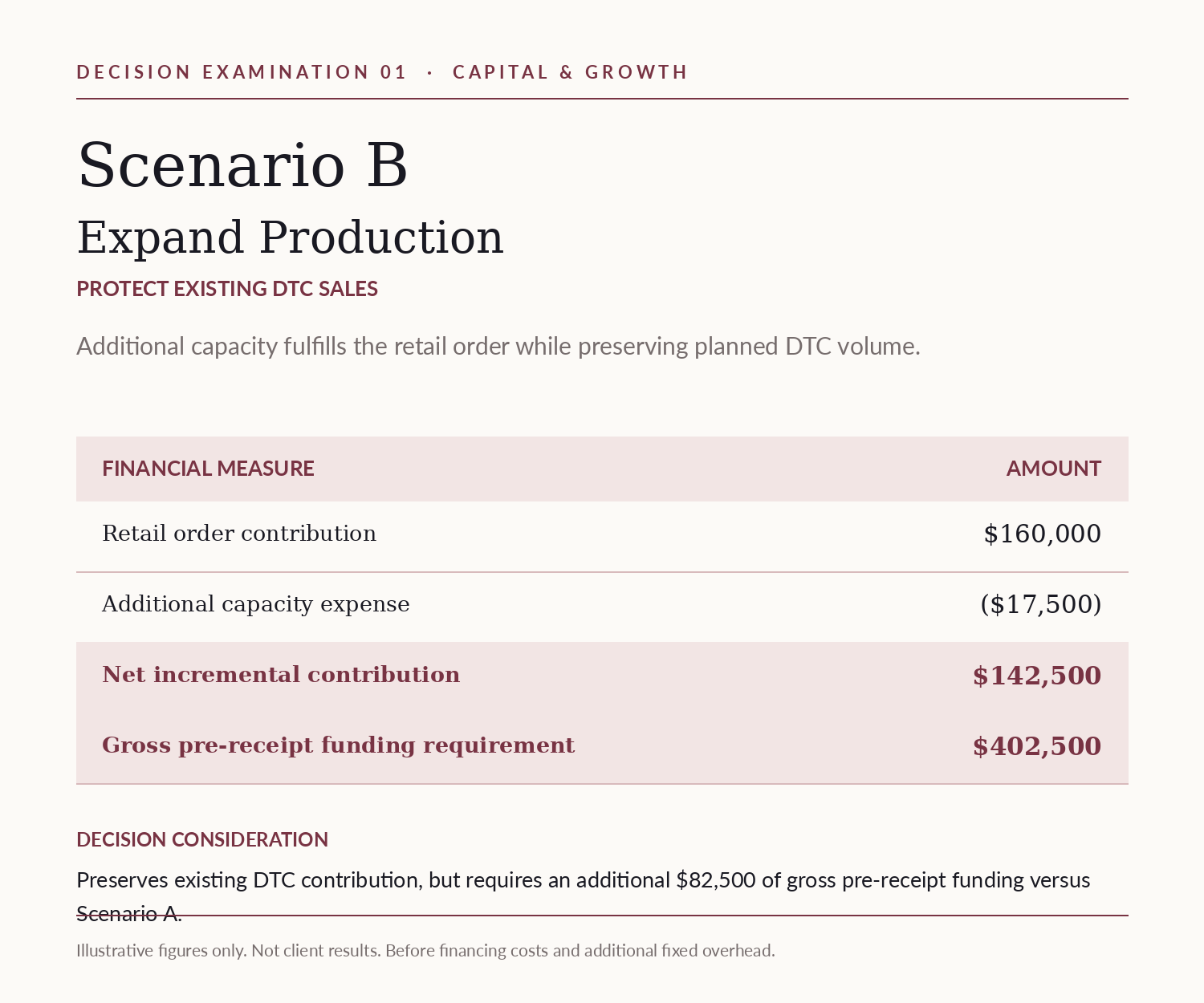
This scenario preserves the direct-to-consumer business and produces substantially greater incremental contribution.
However, it also requires additional working capital to support the protected production volume.
The larger contribution opportunity comes with a greater short-term financing requirement.
Scenario C — Negotiate a Smaller Initial Retail Order
The company proposes an initial commitment of 15,000 units.
This would allow the company to preserve the 5,000-unit direct-to-consumer allocation without purchasing additional production capacity, assuming existing capacity can accommodate both commitments.
This structure provides lower wholesale revenue than the original proposal but preserves the existing channel and reduces the financing requirement.
It may also provide an opportunity to test fulfillment performance and retailer demand before committing to larger volumes.
However, the retailer must agree to the smaller order. The proposed quantity may affect the relationship, shelf placement, or future commercial opportunities.
Comparing the Alternatives
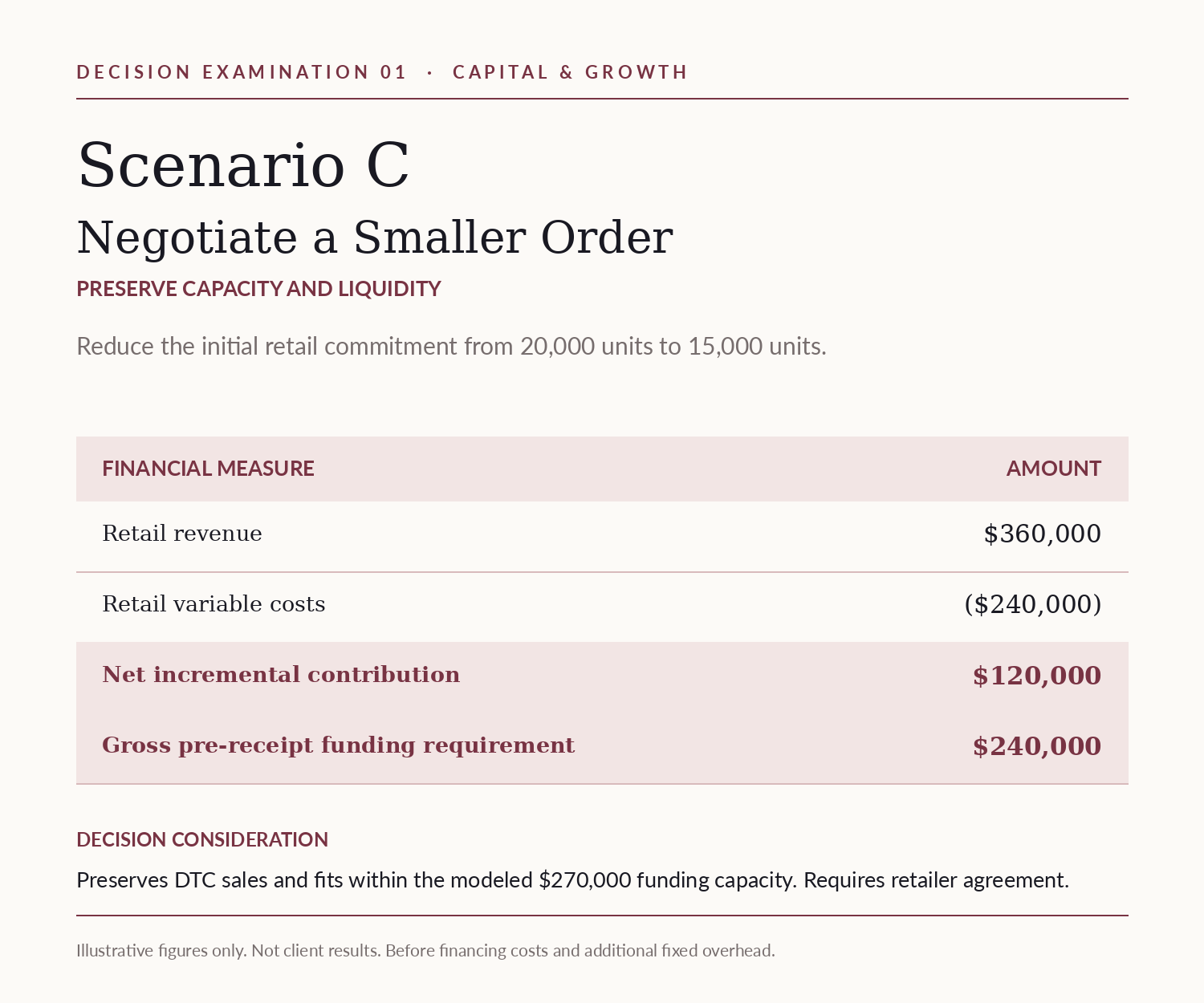
The funding requirements are simplified gross cash commitments before the associated customer receipts. Scenario B includes the additional manufacturing and capacity costs required to protect DTC production, but excludes later DTC fulfillment outflows expected to be funded alongside DTC customer receipts. They are not fully timed, integrated cash-flow forecasts.
The alternative with the greatest revenue is not automatically the alternative with the strongest economic or strategic outcome.
Scenario B offers the greatest incremental contribution under the stated assumptions, while Scenario C requires less funding and preserves greater liquidity flexibility.
Neither can be selected responsibly on contribution alone.
05 — Testing Whether the Opportunity Can Be Reconfigured
Before declining the original order, leadership may examine whether different commercial terms could change its financial requirements.
For example, suppose the retailer agrees to a 30% deposit when the order is placed.
On the original $480,000 order, that would provide $144,000 before fulfillment.
Effect of a Retailer Deposit
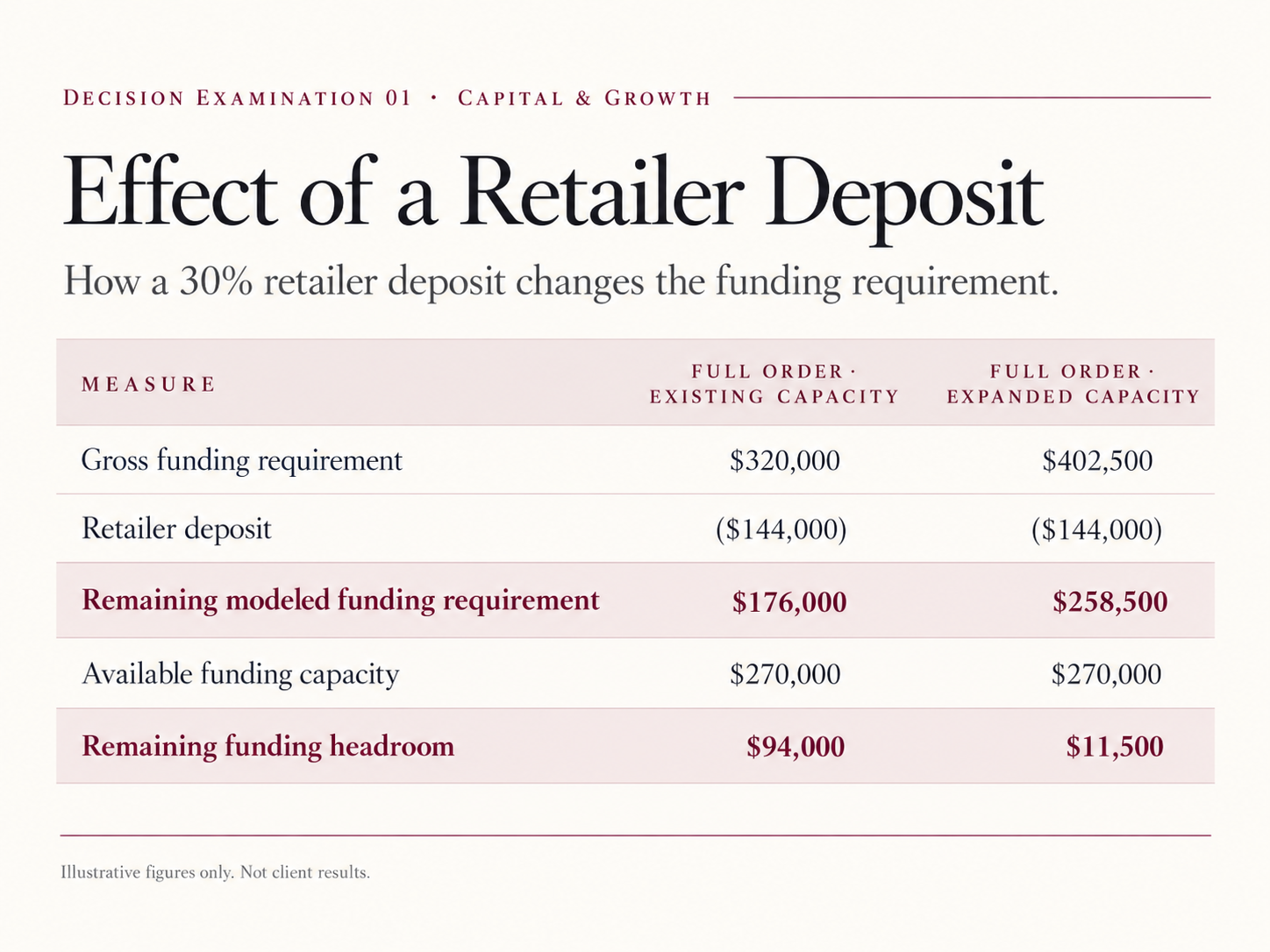
A deposit changes the financing requirement without changing the underlying contribution economics.
Under the simplified assumptions, both versions of the full retailer order now fit within available funding.
But the expanded-capacity scenario leaves just $11,500 of headroom beyond the protected operating reserve.
That limited flexibility may be insufficient if production costs increase, payment is delayed, inventory is rejected, or ordinary business cash needs exceed expectations.
The retailer deposit makes the order potentially financeable.
It does not, by itself, make the commitment prudent.
06 — Examining the Organization Behind the Numbers
The financial analysis establishes what the opportunity may require economically.
The next question is whether the company is organized to fulfill it.
A consequential expansion decision touches several functions simultaneously.
Finance: Who maintains the integrated cash forecast? Who tests payment delays, borrowing costs, and changes in the operating reserve?
Operations: Can manufacturing fulfill the new order without creating quality problems, missed deadlines, or disruption to existing customers?
Commercial leadership: What retailer requirements, deductions, promotional commitments, and future purchasing expectations accompany the opportunity?
Organizational design: Who has authority to approve the production commitment? Who owns inventory allocation? How are conflicts between wholesale and direct-to-consumer priorities resolved?
Executive leadership: What strategic purpose does this retailer relationship serve? What level of risk is acceptable? What evidence would justify expanding the commitment—or walking away?
A company may have capable people in every function while lacking a shared decision process that brings these considerations together.
Without that integration, the founder becomes responsible for reconciling every competing perspective.
The objective is not to add unnecessary complexity to the organization.
It is to establish the financial visibility, decision rights, and coordination required for the company to carry the commitment responsibly.
07 — The Executive Judgment
Under the stated assumptions, accepting the full order while displacing direct-to-consumer production is difficult to justify without a compelling additional strategic benefit.
The company would incur a substantial funding requirement while retaining only $60,000 in incremental contribution.
Expanding production offers stronger economic potential, but requires greater cash commitment and careful operational validation.
Negotiating a smaller initial order provides another possibility: less revenue, but preserved direct-to-consumer contribution and a more manageable initial funding requirement.
A retailer deposit may also improve the feasibility of the larger order, provided timing, execution, and liquidity risks are controlled.
The recommendation is therefore conditional, not automatic.
Before authorizing the commitment, leadership should establish:
A dated, integrated cash forecast that tests the funding requirement, operating reserve, and delayed-payment scenarios.
A confirmed production and inventory plan that identifies capacity constraints, displacement risks, and incremental costs.
Commercial terms and decision authority that establish what must be true for the company to proceed.
The final decision should account for both the modeled economic contribution and the strategic value of the retailer relationship.
What This Examination Reveals
The original question was whether the company should accept a $480,000 retailer order.
The examination reveals a more consequential set of decisions.
How should the opportunity be financed?
Which existing sources of contribution must be protected?
How much operating capacity can be committed?
Which commercial terms would make the order viable?
And what organizational conditions must exist before leadership can responsibly authorize the expansion?
The purpose of integrative executive advisory is not simply to produce a financial answer.
It is to connect economic reality, operating capacity, organizational responsibility, and leadership judgment so that the business can make a decision it is prepared to carry.
About This Examination
This is a fictional, illustrative business scenario developed to demonstrate the financial analysis, operating considerations, and executive judgment involved in The Sovereign Ledger's advisory approach. The figures are hypothetical, the modeling is simplified, and the conclusions are conditional. It does not represent an actual client engagement, verified client result, or individualized financial recommendation.
Consider the Decision Facing Your Business
If your company is evaluating an expansion, major capital commitment, new channel, or strategic investment, the most important question may not be whether the opportunity is attractive.
It may be whether the business is financially and organizationally prepared to pursue it.